
Stefania Gobbi
Planning a Destination Wedding in Tuscany: A Getting Started Guide
Getting married in Tuscany is one of those ideas that arrives fully formed: the villa, the cypress tree lined avenue, the long dinner table under the stars, the light.
What’s less obvious is how it actually works: who you need, in what order, and what trips couples up when they try to organise it all from another country.
But I’m not a wedding planner; and I highly recommend non-Italians to consider getting a wedding planner if you have relatively big plans for your big day!
But I’m a local, a yoga teacher and sommelier who also works as an interpreter, and my experiences at weddings in Italy results in this honest overview I’d give a friend: how it works, who does what, and a few real places and people to point you in the right direction.
Why couples choose Tuscany (and what surprises them)
The appeal is no mystery: the landscape, the food and wine, the sense that the setting does half the work. What surprises couples is usually one of three things.
First, distance makes everything harder to control. Tasting the menu, seeing the venue in person, meeting suppliers: all the things you’d do casually for a wedding at home become trips you have to plan. Second, Italy runs on relationships and paperwork in equal measure, and the right local contact opens doors that a flurry of emails from abroad simply won’t. Third, the legal side is more involved for foreign couples than most expect (more on that below).
None of this is a reason to hesitate. It’s a reason to get the right help early, which is the single most important thing on this page.
First move: hire a local wedding planner
If you take one piece of advice from a local, make it this: a good Tuscan wedding planner is not a luxury, it’s the foundation. A planner who lives here handles the things that are genuinely hard to do from abroad: negotiating with venues, booking and coordinating trusted suppliers, managing the legal paperwork and timelines, translating at meetings, and being physically present when something needs a decision on the day.
DIY-from-abroad is possible, but it’s a part-time job conducted in a second language across a time zone, and it tends to cost more in stress (and often money) than a planner’s fee. A good planner’s local relationships also get you better suppliers and smoother problem-solving than you could arrange alone.
You’ll want to choose your own planner, but a few well-regarded names to start your search, established firms with strong reputations for Tuscan weddings, are Weddings Italy (notably strong around Lucca and the coast), The Tuscan Wedding, and SposiamoVi. Meet a couple before deciding; the right fit matters more than any list. You will also find plenty of planners on websites dedicated to getting married abroad.
The legal essentials, at a glance
I’m not a lawyer either, and the requirements can change and depend on your nationality and circumstances. So always confirm the specifics with your wedding planner and the relevant comune (town hall), and with your own country’s authorities. Treat the below only as a map of the questions to ask.
Broadly, couples marrying in Tuscany choose between three kinds of ceremony:
- Civil: legally binding in Italy, held at a town hall or an authorised venue. If the couple do not speak Italian, they need an interpreter (I just so happen to be one too!) . This is the one with the real paperwork.
- Symbolic: a ceremony with no legal weight, often held anywhere you like, with the legal marriage done quietly at home before or after. Popular with foreign couples because it removes most of the bureaucracy from the day itself.
- Religious: binding or not depending on the faith and the arrangements; needs coordination with both the church and the civil authorities.
Foreign couples typically need documents such as a nulla osta (a declaration that there’s no impediment to marrying), obtained via their embassy or consulate, plus passports and other civil documents, often translated and legalised. The exact list depends on your country. Your planner and the comune are the authorities here, not any blog post or Reddit thread. Speak to the right people.
For document translations and wedding interpreting, you might be interesting in having a look at what I offer at www.stefaniagobbi.com.
Choosing a venue: villa, agriturismo, vineyard or borgo
This is where Tuscany spoils you. The main types:
- Villa: a private historic house with grounds; elegant and self-contained.
- Agriturismo: a working farm estate; relaxed, rustic, often with its own food and wine.
- Borgo: an entire small medieval hamlet, often rented exclusively, so your whole party lives together for the weekend.
- Vineyard or castle: for the postcard backdrop and a strong sense of place.
Some real venues I know in this corner of Tuscany, to make it concrete:
Near Pisa (handy if guests fly into Pisa airport):
- Villa Scorzi, a restored 14th-century villa in a large park at Calci, minutes from Pisa, with on-site ceremonies and accommodation.
- Locanda Sant’Agata, a boutique hotel and restaurant in the countryside of San Giuliano Terme, a few kilometres from both Pisa and Lucca.
- Bagni di Pisa, a thermal spa in San Giuliano Terme, once the Grand Duke’s summer residence; elegant, and wonderful for a spa-minded wedding party.
- Podere San Giorgio, a hilltop estate at Palaia among vineyards and olive groves, about 45 minutes from Pisa airport, and set up to host civil ceremonies on site (confirm the current details with the venue).
In Chianti (the rolling-hills postcard, roughly an hour from Pisa or Florence), two I’ve personally worked at:
- Borgo Petrognano, a quiet 13th-century estate near Barberino Val d’Elsa, with a panoramic terrace and a medieval tower, lovely for intimate weddings.
- Borgo Castelvecchi, a medieval hamlet at Radda in Chianti, rentable exclusively, with a historic cellar and pool overlooking the vines.
A practical tip: choose your venue partly for your guests’ logistics, not just the photos. A Pisa-area venue is far easier for fly-in guests; a Chianti borgo is more immersive but needs cars and more travel time (you can arrange taxis of mini-buses for your guests).
The Tuscan table: food and wine
Catering can be the venue’s own kitchen, or an external caterer you bring in; your planner will advise which suits your venue.
As a sommelier, my one piece of advice is to lean into what’s local rather than recreating a hotel menu: seasonal Tuscan dishes, served family-style, and pick regional wines chosen to match. I would be happy to help with creating your perfect pairings if you wish too.
Also note that Italian weddings always start with a big buffet ‘aperitivo’ (small plates, finger food, usually taken while standing and chatting in a big communal space outdoors), before the sit down meal. This buffet can vary wildly in quality to price ratio. So choose well, to find a menu that will impress your guests but not break your budget. Also try to remind your foreign guests that that isn’t dinner… they need to save space for the main sit down meal, often comprising of 4 or 5 courses!
Ask any caterer how they source, whether they cook on site, and how they handle dietary needs for an international guest list.
A few well-regarded Tuscan caterers to start with: Giovannini Enterprises (a family-run kitchen near Volterra, in the province of Pisa), Galateo Ricevimenti (an award-winning, Florence-based caterer working across Tuscany), and Cerinella (long-established, cooking with local produce). Taste and compare before you commit.
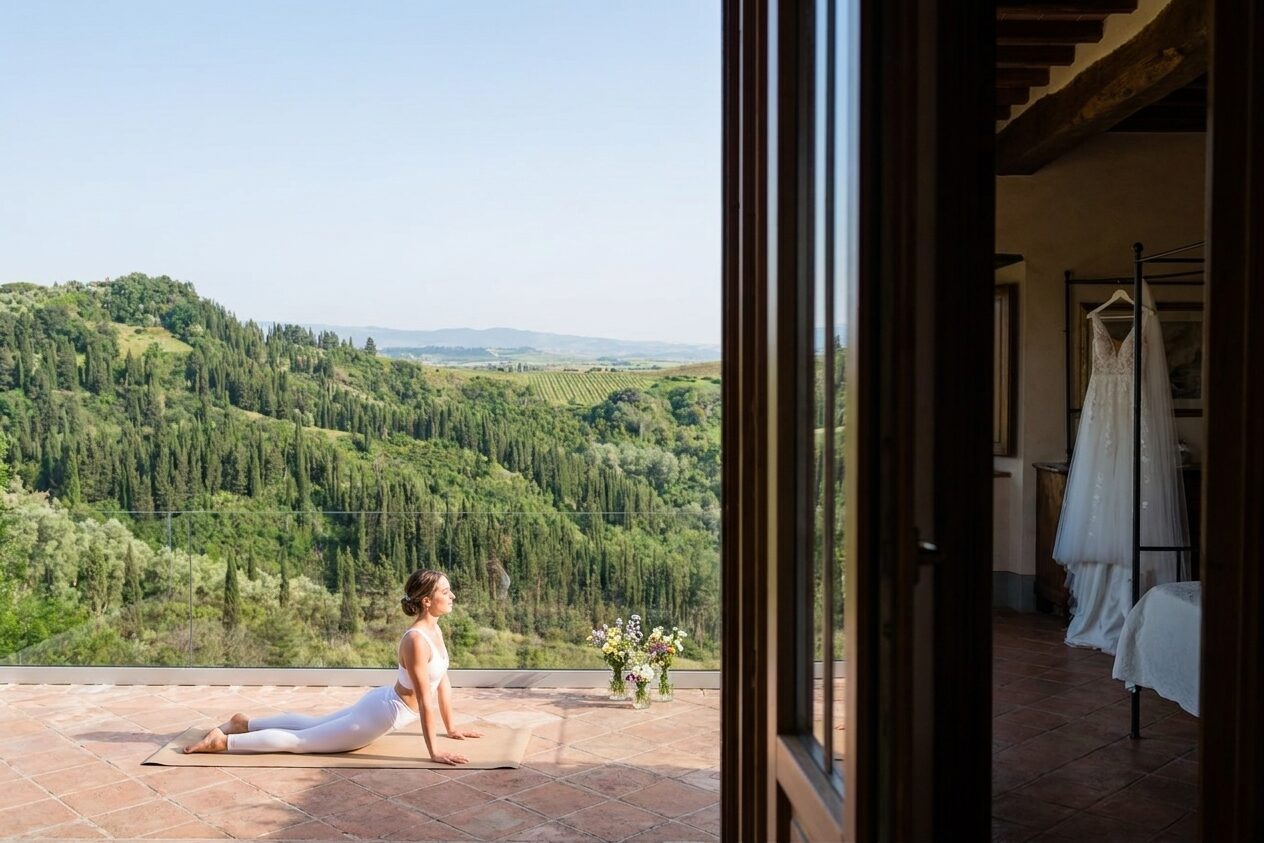
A guided wine moment, whether a tasting for the couple or for guests as a pre-wedding activity, is a lovely, very Tuscan touch; it’s part of what I offer through the yoga and wine experience.
The language gap: don’t underestimate it
Here’s a piece couples routinely forget until late: someone has to bridge the language, and not just socially. A civil ceremony conducted in Italian legally requires an interpreter if either spouse doesn’t understand Italian; the paperwork needs accurate translation; and meetings with suppliers go better with someone who speaks both languages fluently.
This is part of what I do too. Alongside teaching yoga, and working with wine, I work as a professional interpreter and translator, including a dedicated wedding and ceremony interpreting service for civil ceremonies, speeches and supplier meetings. Whether you use me or someone else, build the language help into your plan from the start, not as an afterthought the week before.
Wellness for the wedding party
A wedding weekend is intense, and a little calm goes a long way. A few things I’m often asked to bring to wedding parties, all as relaxed day or half-day sessions, never a full retreat:
- A welcome yoga session for guests the morning after arrival, to shake off the travel and bring everyone together.
- A calm bridal morning: a private, grounding practice for the couple or the bride and her closest people before the day begins.
- A day-after recovery session: gentle movement to ease everyone back to life.
These pair naturally with the yoga and wine experience, and you can read how I approach celebrations on the wedding celebrations page.
A realistic timeline: who to book when
- 12+ months out: set a budget and rough guest count; hire your planner; choose and book your venue (the best go early for peak season).
- 9–12 months: start the legal paperwork research with your planner; book the big suppliers (caterer, photographer); arrange a planning visit if you can.
- 6 months: confirm the ceremony type and get the legal documents prepared; book the interpreter/translator; sort guest accommodation and transport.
- 3 months: finalise the menu and wine with your caterer including dietry requirement, the timeline, and any wellness sessions for the party.
- Final weeks: reconfirm everything; share a guest information pack (addresses, times, travel).
The short version
Tuscany is an extraordinary place to marry, and it rewards couples who get the right local help early. Hire a planner you trust, sort the legal paperwork well ahead, choose a venue that suits your guests as well as your photos, take the language gap seriously, and let the food, the wine and the landscape do what they do best.
If I can help with the language side, a sommelier-led wine moment, or some calm for your wedding party, get in touch. I’m always happy to point you toward local planners and venues worth looking at.


Ready to start your yoga journey?
Book a personalized session with Stefania and discover the benefits of Vinyasa Yoga.
Book Now
Latest posts
Stefania Gobbi
Do You Need an Interpreter to Get Married in Tuscany?
Stefania Gobbi
Do You Need an Interpreter to Get Married in Tuscany?
Stefania Gobbi
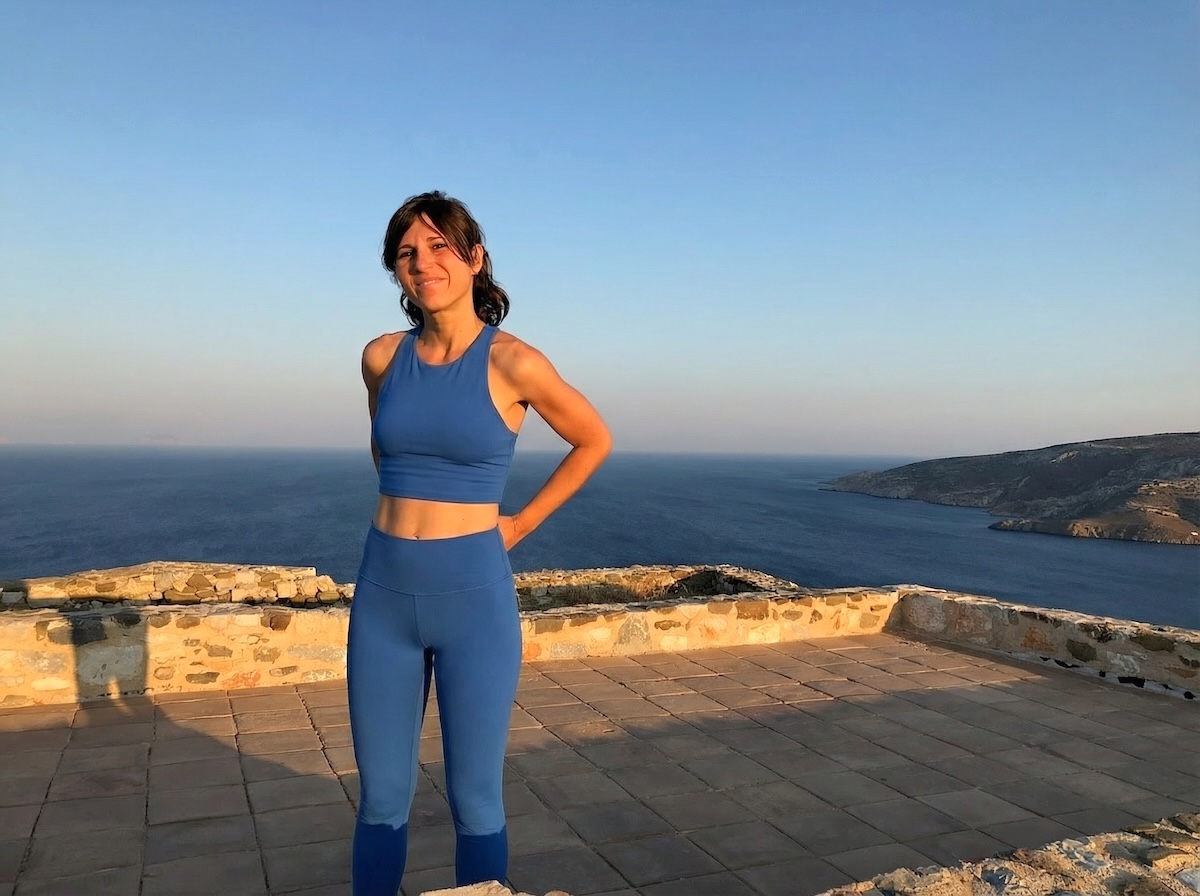
I'm Stefania, a certified Yoga teacher (YTT Jason Crandell Yoga Method) and a Yoga Alliance member. I'm based in the Tuscan hills near Pisa. I've been practicing different styles of yoga for more than 23 years and I can now say that my passion lies in Vinyasa yoga: I'm fascinated by how the physical discipline interweaves with its meditative essence, creating a practice that nurtures both body and mind. As an avid traveller myself, I understand what it means to seek balance while exploring new places. I'm fluent in English, Italian, and Spanish, and also speak French, so we can practice in whichever language feels most natural to you. I'm also an AIS certified sommelier and I'm happy to recommend the perfect local wine to complement your Tuscan experience. I also offer professional interpreting services for visitors to Tuscany.
Book Now