Stefania Gobbi
How to Plan a Hen Do in Tuscany: The Complete Organiser's Guide
So you’ve been handed the hen!
Somewhere between the engagement toast and now, you became the person organising a group of women, some of whom have never met, across a foreign country, on a budget you’re not sure of, for a bride you adore and absolutely cannot let down.
Take a breath.
A hen do in Italy is far less daunting than the group chat makes it feel, and Tuscany in particular rewards the calm planner. This is my guide I wish every organiser had: end to end, in order, from the first decision to the final timeline.
If you only remember one thing, make it this: a hen weekend doesn’t need to be full to be good. It needs to be right. Almost every mistake I see comes from cramming too much in. We’ll build the opposite.
Step 1: Start with the bride, not the destination
Before villas, before flights, before anything, picture the bride on her happiest ordinary weekend.
Is she in a crowd or with her closest five? Up at dawn or up at midnight? Does she want to be looked after, or to look after everyone else?
Everything downstream flows from those answers. A hen planned for the idea of a hen goes wrong; a hen planned for the actual person almost never does. If you want help turning her personality into concrete plans, I’ve written a companion piece on exactly that, classy hen party ideas in Tuscany, with grown-up alternatives sorted by the kind of bride they suit.
One more early task: quietly find out two things from the bride before you plan around them. Her budget ceiling (so no one’s stretched), and her non-negotiables (the friends who must be there, the thing she’d hate). Everything else can be a surprise.
Step 2: Settle the group and the budget, early and honestly
The single kindest thing you can do for a hen group is talk about money first, openly, before anyone’s emotionally committed. Set a realistic per-person total that covers accommodation, travel, food, and one or two activities, and share it before people book flights, not after.
A few principles that keep groups happy:
- Whoever earns least sets the ceiling. If the budget excludes someone the bride loves, it’s the wrong budget.
- Decide the bride’s share up front. Most groups cover the bride’s costs and split them; agree this on day one.
- One pot, one organiser-friendly tool. A shared spreadsheet or a group-payment app saves you from chasing what’s owed for months.
- Be honest about who’s travelling how far. Someone flying in from abroad is already spending more than someone driving over, so factor it into what you ask of them.
Get the headcount roughly fixed at this stage too. Tuscany suits small groups; 4 to 12 is the sweet spot for villas, restaurant tables, and activities that still feel intimate. Much above that and the logistics (and the cost per head) climb fast.
Step 3: When to book what
A rough countdown:
- 9 months ahead: lock the dates with the bride and key guests, set the budget, and book the accommodation. Good villas for summer weekends go early.
- at least 4 months ahead: book flights as a group (or share the best routes), get the best prices
- 3 months ahead: reserve your one or two signature activities and any popular restaurants.
- 6 weeks ahead: confirm transfers and transport, share the itinerary and the packing and dress notes, and collect the money.
- 2 weeks ahead: reconfirm every booking, send everyone a one-page plan (addresses, times, who to call), and stop adding things.
The peak season is roughly May to September, with the heat (and prices) highest in July and August. May, June and September give you warm days, softer light, and more availability.
If you can make it April is a lovely, usually sunny, spring month and if not directly on an Easter week, can also be much more cost-effective.
Step 4: Where to base yourselves
Your base shapes the whole weekend. The four broad options around this corner of Tuscany, honestly compared:
- Pisa and around is the most arrivable base. Galileo Galilei airport has direct flights from much of Europe, so your group lands and is at the villa within the hour. Good if people are flying in from different cities or you’re keeping it to two or three nights.
- Lucca is a walled Renaissance town that’s effortlessly elegant and walkable, ringed by wine hills. Lovely for a group that wants a town on the doorstep and countryside ten minutes out.
- Chianti and the central hills are the postcard Tuscany of vineyards and stone villas. The most romantic base, but you’ll need cars and a willing driver; nothing’s walkable.
- Versilia coast means Forte dei Marmi and Pietrasanta, for a group that wants beach clubs, seafood and a bit of glamour over rustic hills.
My rule of thumb: pick a base for how your group wants to spend the in-between time, not just the headline activity. A group that wants to wander to dinner should be in or near a town; a group happy by the pool can be deep in the hills.
Step 5: Build an itinerary that breathes
The instinct is to fill every time slot. Resist it. The goal is one proper anchor event or activity per day and generous space around it.
A day that breathes looks like: a slow start, one well-chosen experience late morning, a long lunch, an open afternoon (pool, nap, town, spa), and a relaxed dinner. That’s it. That’s a great day. The connection, which is the actual point of a hen, happens in the gaps, not in the activities.
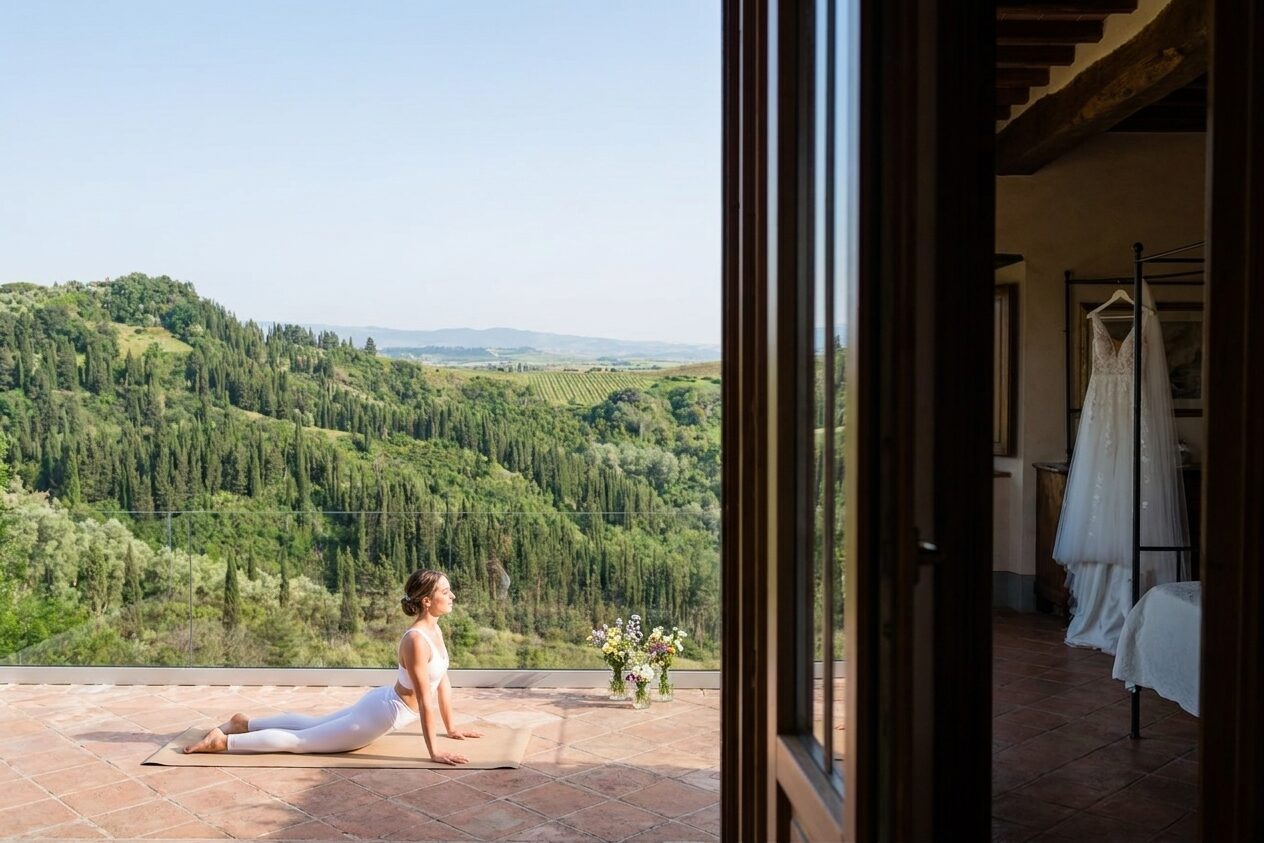
For the signature anchor, my honest recommendation (and yes, it’s what I do) is to make it something the whole group does as equals. The reason a yoga and wine morning works so well as a hen anchor is that nobody arrives an expert: the gentle practice is scaled to the group, and because a sommelier walks everyone through the wine instead of just pouring it, the friends who don’t drink are as involved as those who do. One relaxed centrepiece that includes everyone beats three activities that split the group every time. It’s a half-day held at a winery or other licensed venue, and it leaves the rest of the day open, exactly the shape above.
Whatever you choose as your anchor, whether a cooking class, a vineyard visit or a spa afternoon, apply the same test: does it include everyone, and does it leave room to breathe?
Step 6: Feed everyone well (this is Italy, after all)
In Tuscany, meals aren’t filler between activities; they’re often the best part of the day. A few things worth doing deliberately:
- Book one long lunch or dinner as an “event.” An agriturismo (a farm that cooks what it grows) or a trusted trattoria, a set family-style menu, a couple of unhurried hours. Tell them it’s a hen.
- Italian dining runs late. Dinner at 8:30pm is normal; lunch can stretch to mid-afternoon. Plan the day around that pace rather than fighting it.
- Brief the kitchen on dietary needs in advance, not at the table. Italian cooking is more accommodating than its reputation suggests if you give notice.
If you’ve got a free afternoon and you’re near Pisa, my guide to things to do in Pisa beyond the tower covers the genuinely good stops for a group with a few hours to fill.
Step 7: The practical bits people forget
- Transport between things. Tuscany’s countryside is car country. Either base yourselves somewhere walkable, or arrange a driver for the activity days; splitting a private transfer is often cheaper and far less stressful than two hire cars and a designated driver who can’t enjoy the wine.
- A group that doesn’t all drink. Build in a non-drinking option for every activity. The yoga-and-wine format handles this by design; for a night out, pick somewhere with a proper cocktail and mocktail list.
- Mixed ages. If mums, aunts and twenty-something friends are in the same party, choose anchors everyone can do at their own level (gentle movement, a tasting, a long lunch) rather than anything that quietly excludes the oldest or youngest.
- A quiet plan B for weather. Most Tuscan experiences move indoors gracefully; just check before you book that yours can.
A sample three-day weekend
To make it concrete, here’s a relaxed arc that I could recommend. Adapt freely.
You’ve got this
Planning a hen do in Italy comes down to a handful of calm decisions made in the right order: understand the bride, agree the money early, book the big things ahead, pick a base that fits how you want to spend your time, and build days that breathe around one good event each day. Do that and the weekend more or less runs itself.
When you’re ready to choose an activity, the yoga and wine hen experience is the easiest way to give a Tuscan weekend its calm centre: small groups of 4–12, held at a winery, agriturismo or your hotel, with everything tailored to your group. Tell me about your hen and I’ll put a quote together within 24 hours.


Ready to start your yoga journey?
Book a personalized session with Stefania and discover the benefits of Vinyasa Yoga.
Book Now
Latest posts
Stefania Gobbi
Do You Need an Interpreter to Get Married in Tuscany?
Stefania Gobbi
Do You Need an Interpreter to Get Married in Tuscany?
Stefania Gobbi
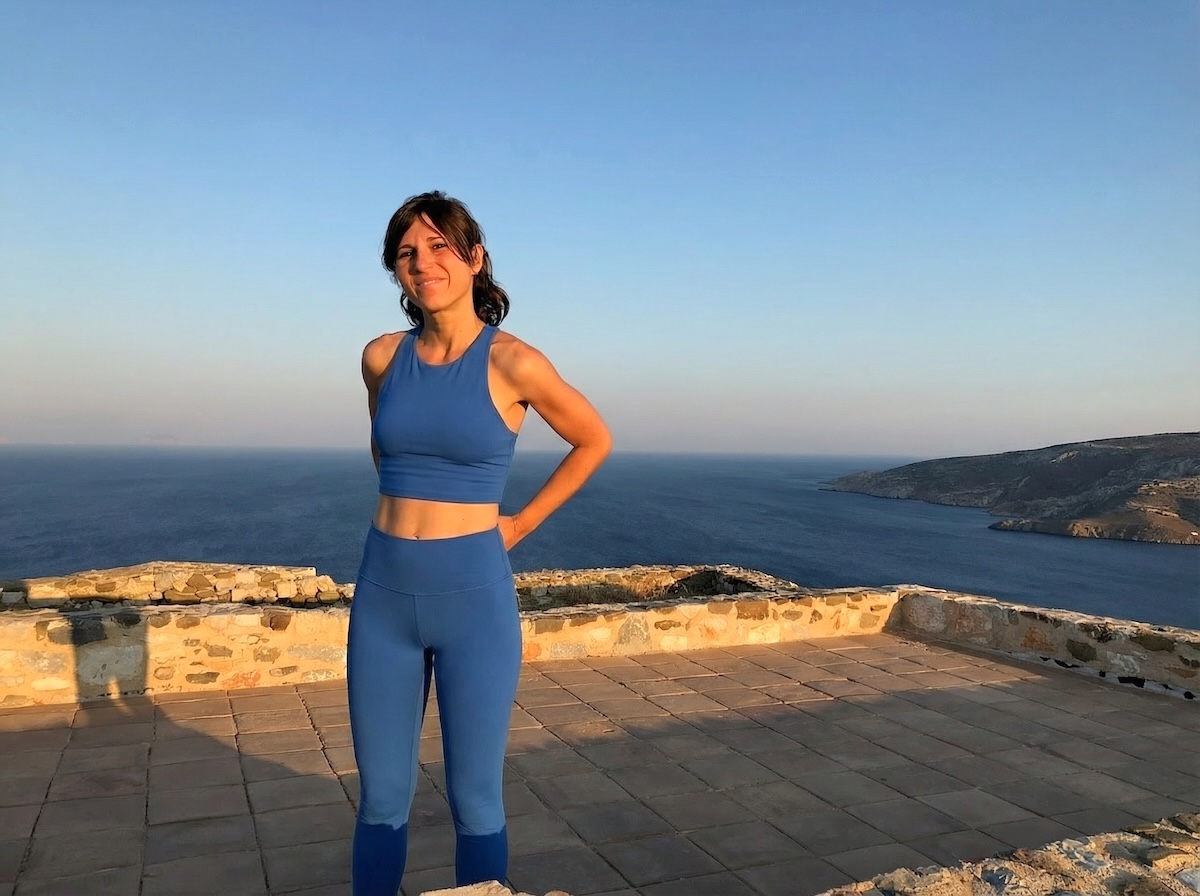
I'm Stefania, a certified Yoga teacher (YTT Jason Crandell Yoga Method) and a Yoga Alliance member. I'm based in the Tuscan hills near Pisa. I've been practicing different styles of yoga for more than 23 years and I can now say that my passion lies in Vinyasa yoga: I'm fascinated by how the physical discipline interweaves with its meditative essence, creating a practice that nurtures both body and mind. As an avid traveller myself, I understand what it means to seek balance while exploring new places. I'm fluent in English, Italian, and Spanish, and also speak French, so we can practice in whichever language feels most natural to you. I'm also an AIS certified sommelier and I'm happy to recommend the perfect local wine to complement your Tuscan experience. I also offer professional interpreting services for visitors to Tuscany.
Book Now